“Good Design” Potato, potahto
I - Introduction
II - Thesis
III - The subjectivity problem
IV - Two perspectives
V - What “Good Design”is not
VI - Finding a working definition
VII - Strategies for reaching a shared definition
VIII - Conclusion
IX - References
Introduction
An anecdote
During my final week working at a former agency I participated in a workshop. It consisted of a large group of talented design experts gathered together to define what “Good Design” meant for the company. The group collected input about aesthetics (beauty), usability, human-centred approaches, winning awards, and other common concepts. At the end we had a long list of typical terms heard when discussing design.
My feeling was that the group was no closer to a definition of “Good Design” than when we started. We had a list of inputs rather than outcomes. In fairness to the group there is a different dynamic when working on a topic like this in a group setting or as an individual. As an African proverb, popularised by U.S. Senator Cory Booker, though poorly evidenced, goes: “If you want to go fast, go alone; If you want to go far, go together.” [1]
I’ve been asking myself how one goes about defining “Good Design” since that workshop ended.
Thesis
In this essay, I will attempt to reach a more concrete definition of “Good Design”. I will map out strategies for teams to arrive at a shared definition. I will also address the problem of subjectivity with terms like “Good” and “Design” to illustrate the challenge of reaching a universal definition.
The subjectivity problem
Like any good designer, I’m starting with the problem. First, there are many interpretations of what “Good” means. Individuals have their own understanding and definition of the relative term "Good". They also have an inherent feeling or understanding of what it means to be good. Think angel and devil on the shoulders… Their view, however, is dependent on their own moral values, belief systems and cultural backgrounds.
What’s good for you might not be good for me. Therefore, a group must collectively arrive at an agreed understanding of what good means.
An example of good being relative can be found in the popular app Uber. Users of the app may find the service good, and the user experience falls within their definition of “Good Design”. That is one user group’s view of the app.
On the other side of the app exists a different user group, the drivers. They have reported unfairness and mistreatment over many issues such as the opaque design of the app’s pricing algorithm. [2]
Same app, different perspective, different opinions of “Good Design”. Good is defined differently when you ask, "Good for whom?"
The second problem is with the term “Design”. Design is broad and spans numerous fields and disciplines. Here is a short list of some design fields to illustrate my point.
Design fields
Visual / Communication Design
Digital Screen-Based Design
Product & Industrial Design
Spatial / Environmental Design
Fashion & Textile Design
Service & Systems Design
Engineering & Mechanical Design
Etc…
Each design field has specialised sub-disciplines that sometimes overlap, but each carries a different context depending on the field, or even the task. Take, for example, the specialised field of UX design that I currently work in. An overarching project could be working on a train system.
One context I'm familiar with could be working for a tech consultancy as a UX designer. There, I would be looking at the customer journey, improving task completion and reducing the bounce/abandonment rates for booking tickets. Focusing on a journey where conversion and efficiency are the priorities.
Another context could be working as a UX designer for the Government on the same train system. Being embedded within the public sector could shift the context of my work to thinking about designing passenger information standards that train operators must follow. Focusing on design systems for policy and procedural standards.
It’s the same design role, on the same project, with different focal points, from different perspectives. The role of UX designer can completely change based on the context.
The author Edward de Bono illustrates this tension in many of his books as an underlying problem in Western culture's thinking. In his book "I am Right, You are Wrong", he speaks of subjective truth: “There is no truth in perception. It is always from a point of view. It is never complete.” [3]
Two perspectives
Let’s look at two perspectives on "Good Design" applied to a single object. Afterwards, you can decide what your subjective truth of “Good Design” is.
May I present to you the humble potato peeler.
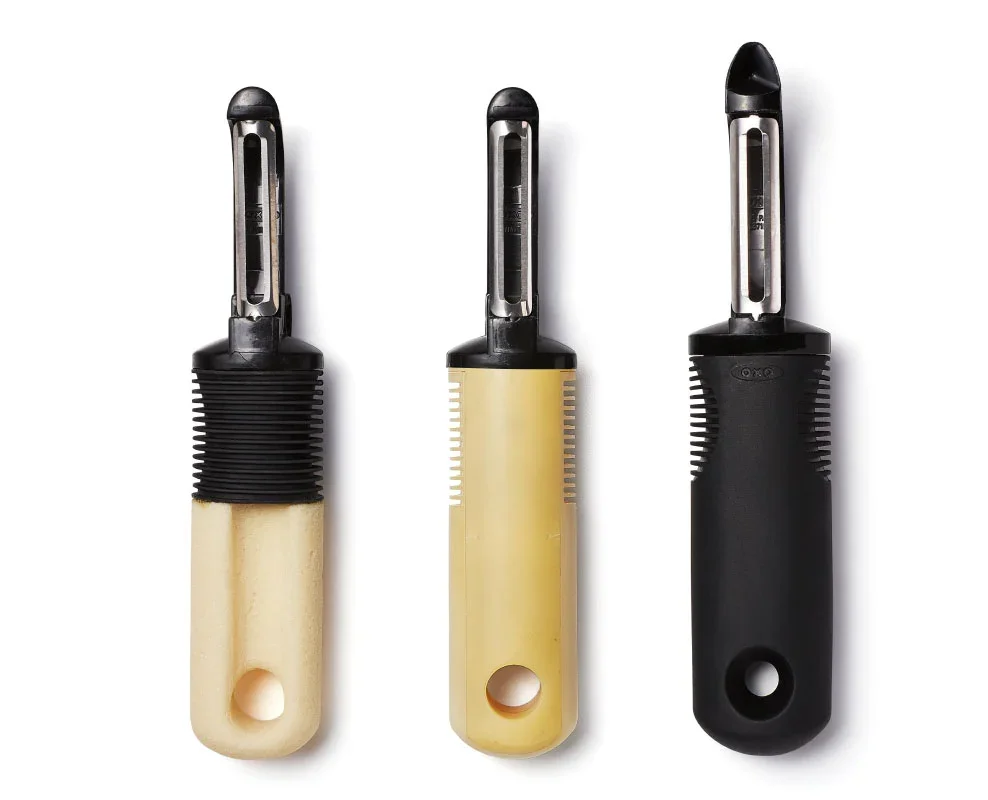
© © OXO / Sam Farber, 1990
First, let’s look at the award-winning design from OXO. OXO got its start with the redesign of the potato peeler. As the story goes, the company founder Sam Farber was cooking with his wife Betsey Farber, who had arthritis in her hands. He recognised her struggle with traditional potato peelers and decided to redesign a handle that was easier for her to use. [4]
This design approach is known as “Inclusive Design”. The idea is that if you solve a problem for edge-case users, all users benefit.
Now let’s look at the classic Swiss potato peeler, created in 1947 and known as the “REX peeler”.
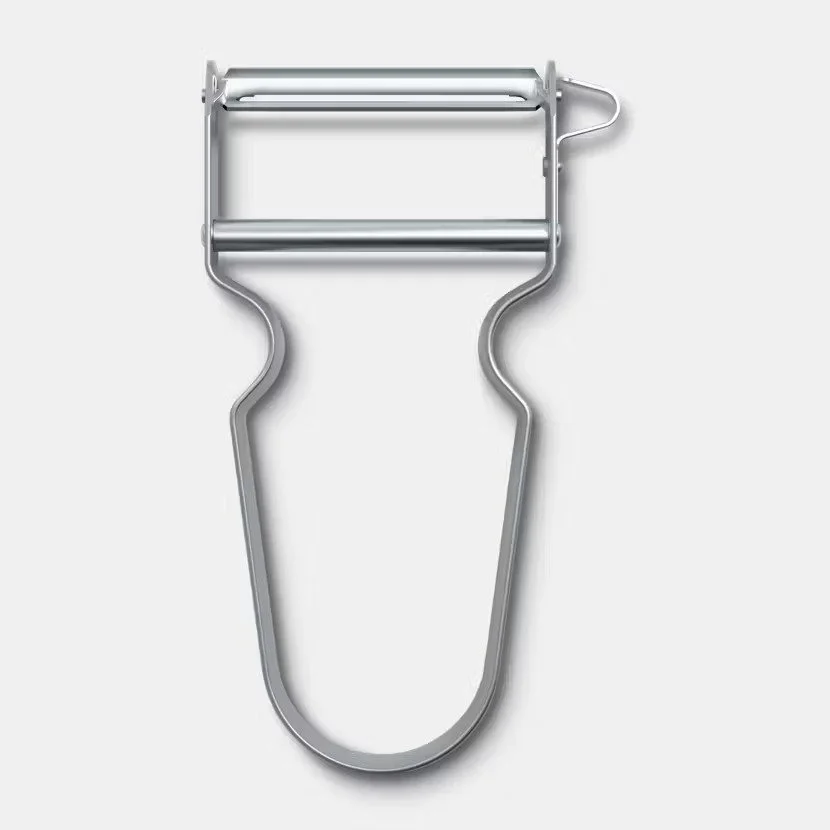
© Victorinox / Alfred Neweczerzal, 1947
It is iconic Swiss Design, has minimal parts and materials, is comfortable to hold, and very affordable. Created by Alfred Neweczerzal because he had problems peeling potatoes in the military. He fashioned the design to make it easier for himself. This object is such an iconic part of Swiss Design history I have a poster with this potato peeler on it in my kitchen, created by designer Irma Boom [5] for the design exhibition: Everything Design, Museum für Gestaltung Zürich 2009. [6]
To resolve the subjectivity problem of “Good Design”, we must define: Good for whom, by which standard, in which cultural context, and even in which time frame throughout history. I will explain how this can be achieved in the Finding a Working Definition section of this essay.
What “Good Design” is not
Beauty
We all like beautiful things. We look for and strive to find beauty in this world. The problem is that beautiful things can fail. A design can look good and fall short of its intended goals or fail to serve its purpose.
Paul Rand in his book, “Thoughts on Design”, when describing “Good Design” speaks to the point of beauty not being enough when he says, “form and function: the integration of the beautiful and the useful.”. [7]
Usable
When it comes to usability, sometimes the more important aspect of usefulness gets overlooked. A design might be easy to use but not contain any meaning or value for the audience using it. Understanding your audience and their needs informs the values and priorities for what is “Good”.
Understand who. Understand what they need, also what they don’t need.
Accolades
Sometimes winning awards might be your priority if you are a creative director. Awards could have an impact on your budgets and future clientele. Your framing of what "Good Design" is will probably be based on what is novel, gets noticed, and is likely to win awards.
An award-winning campaign can check all of the boxes for a jury to award a prize, but have little impact for the client it serves or the audience it speaks to. In some cases projects are purely invented for winning awards with little to no relevance for the reality of the client or audience. The difference between design as self-expression and "Good Design" is that the work serves an audience to fulfil a purpose for others.
Are any of these examples what you would classify as “Good Design”?
On their own, most likely not. With a working list of what does not qualify as “Good Design”, we can start to home in on the aspects of a definition of “Good Design”.
Finding a working definition
Where to start
As a professional designer you will most likely work in a diverse range of industries and contexts. So the question becomes, how do you find the frame and context for your definition of “Good Design”? To have a working definition, you want to determine and limit the scope of your definition.
Scoping your definition
For what purpose (The goal, the why)
For whom (Target audience)
The standard (Established benchmarks)
The context (Culture, design medium)
The timeframe (Current market, future vision)
The shortest way to understanding the context of your design work is to dive deeper into understanding your clients or companies business. These questions sit squarely in business strategy territory. Companies usually have a mission and a purpose statement. They often have defined target audiences and personas (the "who") they try to reach. There are benchmarks/standards within their industry. There is usually a focus on a country and culture where they operate. The business strategies adapt and adjust over time.
The result of an aligned design and business strategy is a coherent and consistent brand identity. I learned this lesson during my time working as a brand designer. I worked closely with Brand Strategists to develop brand identities for clients across many industries. The context of what “Good Design” was changed for each client and each industry. By understanding the business strategy of a company, you can define and limit the range of your definition of “Good Design” in an effective and appropriate way.
This idea is best described by Marty Neumeier in his book "The Brand Gap". Marty describes the gap this way: “Whenever there is a rift between strategy and creativity, between logic and magic, there's a brand gap… The gulf between strategy and creativity can divide a company from its customers so completely that no significant communication passes between them.” [8]
Dimensions of context for your definition
Who asks “Is this good?”
What is the company’s story?
What does the industry care about?
Where does your creation sit on the spectrum from trendy to timeless?
Strategies for reaching a shared definition
To gain an understanding of “Good Design” in a group, I like to use design principles. The principles can be created in a workshop with all participants contributing. They help define the outcome, goal, and intent of your design.
I follow the process laid out by Ben Brignell in his field guide: “Design Principles in Practice”. [9] Here is the anatomy of a “Good Design” principle Ben presents:
Design Principle Anatomy
A memorable title that prioritises clarity over cleverness
A sentence that describes the intent and the implications of the principle
An example in use
“Good Design” principles are clearly stated, actionable and have consequences. They are used to resolve conflicts, keep teams aligned, and move things forward. They are also a foundational pillar of a design system as stated by Alla Kholmatova in her book “Design Systems, A practical guide to creating design languages for digital products”. [10]
Of course, when I talk about design principles, I would be remiss not to mention Dieter Rams and his “Ten Principles of Good Design”. [11] His are among the best examples of design principles that have held up over the ages.
If you would like to explore far beyond the principles from Dieter Rams, I recommend browsing the vast examples of existing principles that Ben Brignell has collected on his website: https://principles.design/examples/
Conclusion
I’ve shown that “Good Design” is more than just form and function. By integrating context and finding alignment, you can arrive at a common definition of “Good Design”.
When you understand the subjectivity problem with the term “Good Design” you can address it by framing a definition based on a business strategy related to your design task. Design principles then act as a device for expressing what “Good Design” means, helping teams make actionable choices in their work.
When I revisit the workshop story presented at the outset of this essay, the next steps following the initial workshop would be comparing the list created by the designers to the agency's business strategy. Then running another workshop using the terms related to the business strategy to create 3-5 design principles and work with the principles for a few weeks before holding a review session where we could adjust and refine them.
“Good Design” is when creative magic and business logic are aligned in purpose: to serve the right audience at the right time.
Hopefully I've given you a workable process for defining what “Good Design” means. Working on a definition is itself a creative act of design. Designers are well suited to the task. They just need to frame the scope and ideate the definition using the tools they already know. Similar to any other design problem they face.
Of course, this is my personal/professional perspective on the topic. I’m open to hearing and learning from other perspectives. As I mentioned we all have our own subjective realities. Thanks for reading,
Merlin
P.S. Which potato peeler is your favourite?
Has your team ever actually landed on a shared definition of “Good Design”, or did you end up with a list of adjectives too?
References or works cited in essay
1. Goldberg, Joel. “It Takes a Village to Determine the Origins of an African Proverb.” NPR, 30 July 2016, www.npr.org/sections/goatsandsoda/2016/07/30/487925796/it-takes-a-village-to-determine-the-origins-of-an-african-proverb.
2. Winshell, Jason, and Jason Winshell. “Drivers Protest Uber’s ‘Black Box’ Fare System.” San Francisco Public Press, 6 Nov. 2025, www.sfpublicpress.org/drivers-protest-ubers-black-box-fare-system.
3. De Bono, Edward. I Am Right, You Are Wrong. Penguin UK, 2017, p. 46.
4. OXO. “About Us.” www.oxo.com, www.oxo.com/we-are-oxo/aboutus. Accessed 20 July 2026.
5. Posters Museum Für Gestaltung Zürich: Every Thing Design / Gold. eshop.museum-gestaltung.ch/?op=product&id=7536.
6. Swissinfo.Ch. “Rex The Peeler Is King of the Kitchen.” SWI swissinfo.ch, 28 Jan. 2024, www.swissinfo.ch/eng/archive-banking-fintech/rex-the-peeler-is-king-of-the-kitchen/5486616.
7. Rand, Paul. Thoughts on Design. Chronicle Books, 2014, p. 9.
8. Neumeier, Marty. The Brand Gap, Revised Edition. Peachpit Press, 2005, p 15.
9. “Design Principles in Practice.” Design Principles, principles.design/field-guide.
10. Kholmatova, Alla. Design Systems: A Practical Guide to Creating Design Languages for Digital Products. 2017.
11. Good Design | About Us | Vitsœ. www.vitsoe.com/rw/about/good-design#ten-principles-for-good-design.